
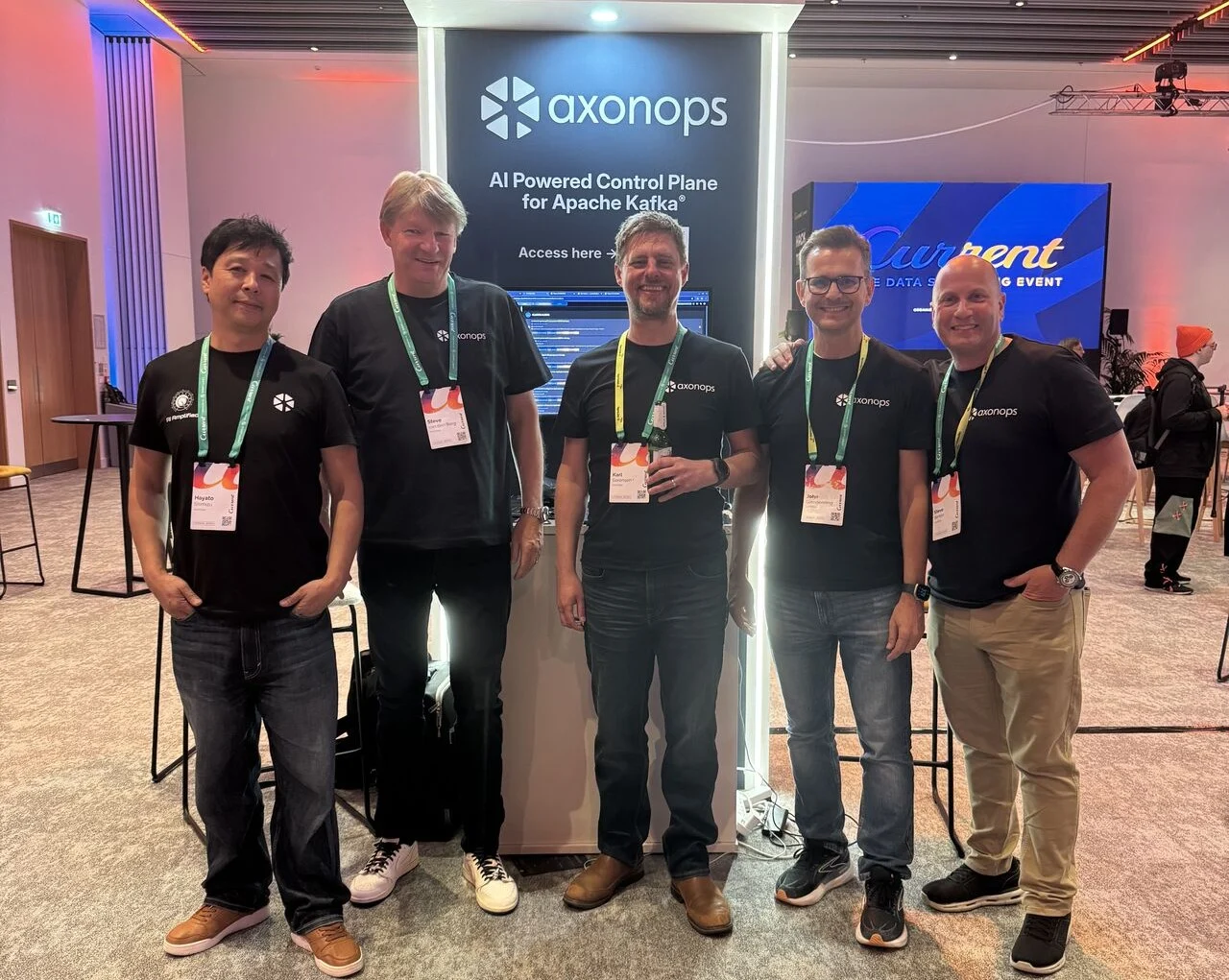
Two days at London ExCeL
Current London 2026 is done, and after two days at ExCeL talking with Kafka practitioners from across the community, we came away with a long list of people to thank.
This was our first Current event since releasing the AxonOps Kafka product, and it was also the first time we had shown the new AI features publicly in this setting, so this one felt different for us from the outset because we were not just there to introduce ourselves, we were there to show where the product is going and to see whether that direction would resonate with people living with Kafka every day.
This post is a thank you to the people who made the event what it was, and also a short note on what we heard most often at the AxonOps stand.
Thank you to Confluent
Putting on an event of this scale takes a real team behind the scenes, and the Confluent crew running Current London did it well because the schedule held together, the venue logistics at ExCeL worked, and the whole event still felt like it had engineers in mind.
Thank you to everyone at Confluent who pulled it off, because an event of this size does not feel engineering-led by accident.
Thank you to the speakers and fellow sponsors
To the engineers who got up on stage and shared what they are doing with Kafka in production, thank you, because the sessions page was full of subjects people are dealing with right now, including KRaft migration, queue semantics in Kafka, Strimzi and Kubernetes operating models, real-time data pipelines, autoscaling, governance, and the practical overlap between streaming systems and AI.
That was one of the strongest parts of the event for us, because the talks stayed close to the work people are actually doing and those sessions gave everyone something real to react to once they came back onto the floor afterwards.
Thank you also to the other sponsors, the open-source maintainers, and the partner teams we spent time with between sessions, because a lot of the best conference moments happen away from the stage and this event had plenty of those.
The AxonOps AI-Powered Kafka response
The strongest reaction at the stand was to the AI features, and that became obvious quite quickly because people would stop and ask what we were showing, then stay much longer once they saw chat, root cause analysis, and recommendations working against real Kafka operational data.
People were not reacting to AI as a label so much as to AI tied to real operational work, because a chat interface grounded in live Kafka state made sense to them, root cause analysis on alerts made sense to them, and recommendations across configuration, reliability, performance, capacity, and security also made sense, which is why we were genuinely taken aback by how positive the response was.
If you want a clearer view of what we are building there, see the AxonOps AI page.
What we heard on the floor
Across the two days at the stand, a few themes came up again and again once the AI conversation started to open up into wider operational discussions.
The cost of Kafka in 2026. The numbers from our recent analysis kept surfacing in conversation because the gap between self-hosted, Amazon MSK, and Confluent Cloud is wider than most teams expect, especially as cluster size grows, and reactions ranged from quiet validation to genuine surprise. If you want the underlying breakdown, our Kafka cost comparison covers the three operating models with real pricing.
Operating Kafka without a dedicated platform team. This question came up from smaller engineering organisations and from larger ones whose platform team has been quietly shrinking, because the shared concern was how to keep Kafka stable when nobody owns it full time, which is exactly the pattern we wrote about in Running Kafka at Scale Without a Dedicated Platform Team.
Strimzi, Kubernetes, and the operator pattern. A meaningful number of teams are running Kafka on Kubernetes through Strimzi, or planning to, and the conversations were mostly about the trade-offs the operator gives you and the gaps it leaves around observability and day-2 operations. Our technical write-up Strimzi with AxonOps covers how we approach those gaps.
Self-hosted and air-gapped Kafka environments. A significant number of people we spoke with were running Kafka in self-hosted environments, and some of them were in air-gapped deployments where managed tooling is simply not an option, so it was striking how many people said straight out that the AxonOps approach looked like a very good fit for the kind of controlled environments they have to operate in.
What is next
If we spoke at the stand and you want to pick the conversation back up, send us a note through the contact page, or try the self-service sandbox for a hands-on look at the AI Control Plane for Apache Kafka, including chat, root cause analysis, and recommendations.
Thank you again to everyone who stopped by and spent time with us, because we came away tired but encouraged and with a lot to think about.
It was also genuinely nice to see some familiar ex-DataStax faces at the event. Ale Gutierrez, Tim Berglund, and Jonathan Lacefield were all former colleagues, so having a chance to catch up in London made the event feel even more special.
Until next time.